
- What is IRR and Why It Matters
- IRR Calculator Step by Step Example: The Scenario
- Step 1: Gather Your Cash Flow Data
- Step 2: Input Cash Flows into the IRR Calculator
- Step 3: Interpret the Result
- Step 4: Understand the Iterative Nature of IRR Calculation
- Step 5: Consider Multiple IRRs and Limitations
- Final Thoughts: Mastering IRR with a Calculator
IRR Calculator Step by Step Example: A Clear Guide to Understanding Internal Rate of Return
Using an IRR calculator step by step example can simplify the process of determining the internal rate of return (IRR) on your investments, making it easier to evaluate the profitability of projects or financial ventures. IRR is a critical financial metric used to estimate the rate at which an investment breaks even in terms of net present value (NPV). For many investors, business owners, and finance students, grasping how an IRR calculator works through a clear example helps demystify this powerful yet sometimes confusing concept.
In this article, we’ll walk through a comprehensive, easy-to-follow IRR calculator step by step example. You’ll learn not only how to use the calculator but also understand the fundamentals behind each stage of the calculation.
What is IRR and Why It Matters
Before diving into the example, it’s important to understand what IRR represents. The internal rate of return is the discount rate that sets the net present value (NPV) of all cash flows from an investment equal to zero. In simpler terms, it’s the expected annualized rate of growth an investment is projected to generate.
Knowing the IRR helps investors compare different opportunities and decide which ones will likely yield higher returns. A project with an IRR higher than the company’s required rate of return or the cost of capital is typically considered a good investment.
IRR Calculator Step by Step Example: The Scenario
Imagine you’re considering an investment project that requires an initial outlay and promises future cash inflows over several years. Here’s the data you’ll input into the IRR calculator:
- Initial Investment (Year 0): -$10,000 (negative because it’s a cash outflow)
- Year 1 Cash Inflow: $3,000
- Year 2 Cash Inflow: $4,000
- Year 3 Cash Inflow: $4,000
- Year 4 Cash Inflow: $3,000
You want to determine the project’s internal rate of return to assess whether it’s a worthwhile investment.
Step 1: Gather Your Cash Flow Data
The first step is organizing all the cash flows associated with the investment by year. Starting with the initial investment (always a negative number), followed by the positive cash inflows in the subsequent years.
| Year | Cash Flow |
|---|---|
| 0 | -$10,000 |
| 1 | $3,000 |
| 2 | $4,000 |
| 3 | $4,000 |
| 4 | $3,000 |
This timeline is the backbone of your IRR calculation.
Step 2: Input Cash Flows into the IRR Calculator
Most IRR calculators, whether online tools, Excel, Google Sheets, or financial software, require you to input these cash flows as a series. For example, in Excel:
- Enter the cash flows in cells A1 through A5 (or any other column).
- Select an adjacent cell and type the formula:
=IRR(A1:A5). - Press Enter, and the result will be the IRR expressed as a decimal (for example, 0.138 or 13.8%).
If you are using an online IRR calculator, you simply enter the values sequentially and click calculate.
Step 3: Interpret the Result
Let’s say the IRR calculator returns 13.8%. This means your project is expected to generate an annual internal rate of return of 13.8%.
Now, compare this figure to your company’s benchmark or the cost of capital. For example, if the required rate of return is 10%, this project looks attractive because the IRR exceeds that threshold. Conversely, if the cost of capital is 15%, this investment may not meet your returns requirements.
Step 4: Understand the Iterative Nature of IRR Calculation
It’s important to note that IRR calculations rely on trial and error or iterative methods to find the rate that sets the NPV to zero. That’s why most people use calculators or spreadsheet functions rather than solving manually.
If you were to solve manually, the formula for NPV would be:
[
NPV = sum_{t=0}^{n} frac{C_t}{(1+IRR)^t} = 0
]
Where (C_t) represents the cash flow at time t.
You would adjust the IRR value repeatedly until NPV equals zero, which is time-consuming and impractical without a calculator.
Step 5: Consider Multiple IRRs and Limitations
Sometimes, investments with alternating positive and negative cash flows can yield multiple IRRs or none, which complicates decision-making. The IRR calculator will usually just give you one rate, so understanding the context is crucial.
Additionally, IRR assumes all intermediate cash flows are reinvested at the IRR rate itself, which may not always be realistic. Therefore, using IRR in combination with other metrics like NPV is recommended.
Final Thoughts: Mastering IRR with a Calculator
An IRR calculator step by step example like this one arms you with practical know-how and confidence to evaluate investment opportunities on your own. By systematically gathering your cash flow data, inputting it into a calculator, and interpreting the results, you can make informed financial decisions.
Investors, finance professionals, and students alike benefit greatly from understanding how to use IRR calculators correctly. Practice with different cash flow scenarios to deepen your understanding and ensure you’re making sound investment choices.
Remember, tools like IRR calculators are only as powerful as the data and assumptions you feed into them, so precision and context are key. With this step-by-step guide, you’re well on your way to mastering the internal rate of return!
📱 Calculate Instantly with FinLaa
Access 116+ financial calculators — EMI, SIP, tax, mortgage & more — completely free. Works offline too.
iPhone · iPad · Mac · Apple Vision Pro
📚 Related Articles
🔗 Official Resources
Author

rahulbachioppo@gmail.com
Related Posts

how much should I invest every month to become rich
Wealth creation is a marathon, not a sprint. Smart investing is about time in the market, not timing the market. In this...
Read out all
what is SIP and should I start one now
Wealth creation is a marathon, not a sprint. Smart investing is about time in the market, not timing the market. In this...
Read out all
should I prepay my loan or invest the extra money
Taking a loan is a big commitment. Whether it’s for a home, car, or personal use, valid calculation is your first defense...
Read out all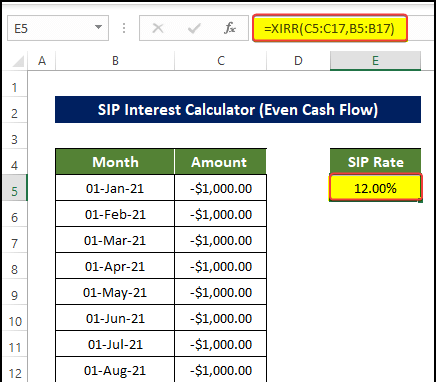
SIP and EMI calculator step by step explanation
Taking a loan is a big commitment. Whether it’s for a home, car, or personal use, valid calculation is your first defense...

how to start investing in mutual funds for beginners
Wealth creation is a marathon, not a sprint. Smart investing is about time in the market, not timing the market. In this...
Read out all
tell me how compound interest works
Taking a loan is a big commitment. Whether it’s for a home, car, or personal use, valid calculation is your first defense...
Read out all