- What is Debt to Income Ratio?
- Why Use a Debt to Income Ratio Calculator UK?
- How to Calculate Debt to Income Ratio
- What Counts as Monthly Debt Payments?
- What Counts as Gross Monthly Income?
- Example Using a Debt to Income Ratio Calculator UK
- What Does Your Debt to Income Ratio Mean?
- Tips to Improve Your Debt to Income Ratio
- Using Online Debt to Income Ratio Calculator UK Tools
- Conclusion
Understanding Debt to Income Ratio Calculator UK Example: A Comprehensive Guide
When managing your personal finances in the UK, the debt to income ratio calculator UK is an essential tool that can help you understand your financial health. Whether you’re applying for a mortgage, a loan, or just trying to get a clearer picture of how your debts relate to your income, knowing your debt-to-income (DTI) ratio can provide valuable insights and improve your financial decision-making.
In this article, we’ll explore what a debt to income ratio is, how a debt to income ratio calculator works in the UK, and provide a detailed example to help you get started.
What is Debt to Income Ratio?

The debt to income ratio is a simple yet powerful figure that compares your monthly debt payments to your gross monthly income (your income before taxes and other deductions). Lenders often use this ratio to assess your ability to manage monthly payments and repay debts.
A lower DTI ratio generally represents better financial health, indicating you have more income available to cover debts, while a higher DTI might suggest overextension and higher financial risk.
Why Use a Debt to Income Ratio Calculator UK?
In the UK, understanding your debt to income ratio is especially important when applying for credit products like mortgages, personal loans, or credit cards. UK lenders use your DTI to determine whether you qualify for a loan or credit and what terms to offer.
A debt to income ratio calculator UK simplifies this process by taking your income and your current debts as inputs and instantly calculating the ratio for you. It removes the guesswork and provides a clear picture of your financial standing.
Using such a calculator routinely can help you:
- Keep track of your financial commitments
- Plan your budget better
- Avoid taking on debts that may become unmanageable
- Improve your chances of loan or mortgage approval
How to Calculate Debt to Income Ratio
The formula for debt to income ratio is straightforward:
DTI Ratio = (Total Monthly Debt Payments / Gross Monthly Income) × 100%
What Counts as Monthly Debt Payments?
- Mortgage or rent payments
- Minimum credit card payments
- Car loan payments
- Personal loans
- Student loans
- Any other recurring debt payments
What Counts as Gross Monthly Income?
- Salary before taxes
- Bonuses and commissions
- Rental income (if consistent)
- Any other steady income sources
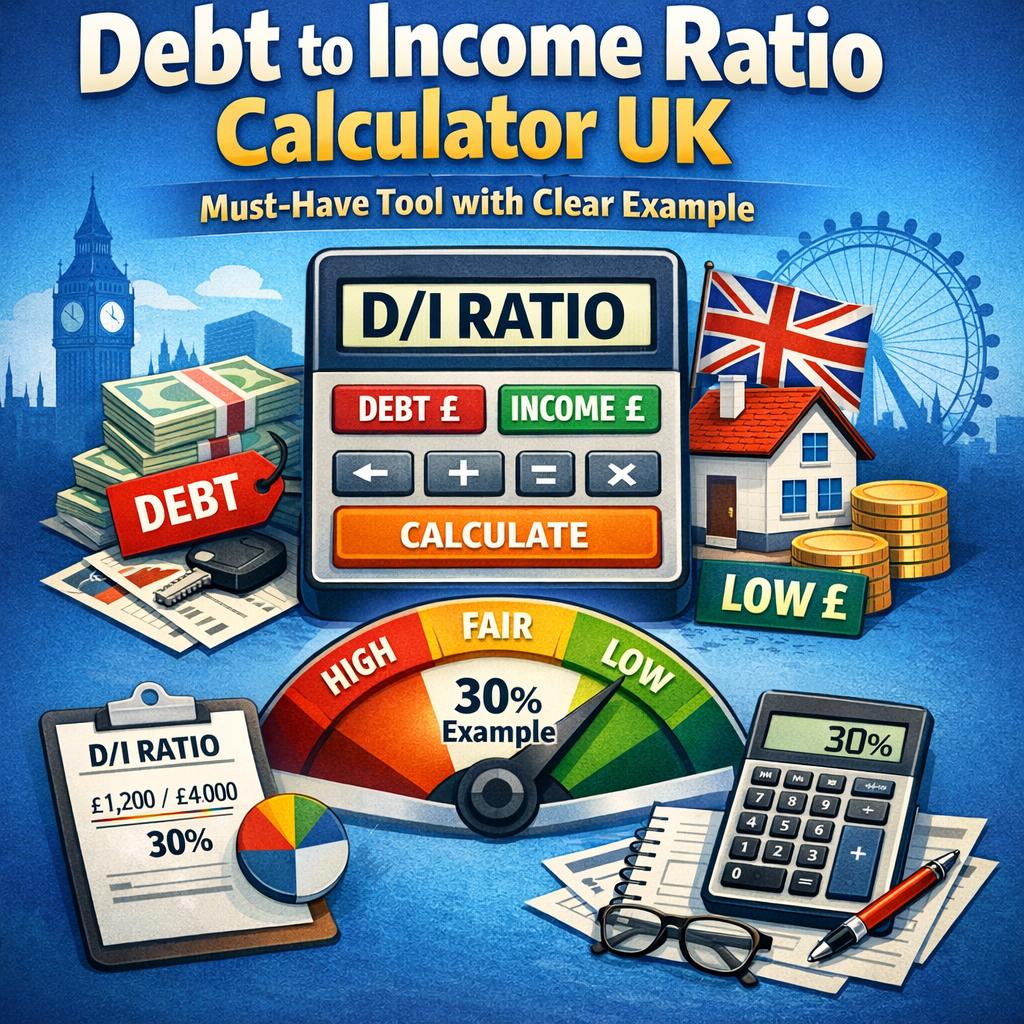
Example Using a Debt to Income Ratio Calculator UK
Let’s consider an example to illustrate how you might use a debt to income ratio calculator in the UK:
- Gross monthly income: £3,500
- Monthly mortgage payment: £900
- Monthly car loan payment: £250
- Minimum credit card payments: £150
- Other loan payments: £100
Step 1: Calculate total monthly debt payments
£900 + £250 + £150 + £100 = £1,400
Step 2: Calculate DTI Ratio
( frac{£1,400}{£3,500} times 100 = 40% )
In this example, the individual’s debt to income ratio is 40%.
What Does Your Debt to Income Ratio Mean?
UK lenders typically prefer a DTI below 35%-40%, though this can vary by lender and loan type. Let’s break down common risk categories:
- Below 35%: Generally considered good. You’re likely seen as a low-risk borrower.
- 35% to 43%: Acceptable but may lead to stricter loan conditions.
- Above 43%: Typically considered high risk; lenders might reject your application or require higher interest rates.
Knowing where you stand can help you target areas to reduce debt or increase income before applying for major financial commitments.
Tips to Improve Your Debt to Income Ratio
If your DTI ratio is higher than you’d like, here are a few tips to help improve it:
- Increase your income: Consider side hustles, asking for a raise, or finding higher-paying work.
- Pay down debts: Focus on paying off smaller loans or credit cards first to reduce monthly obligations.
- Avoid taking on new debt: Try not to increase your monthly payments, especially before loan applications.
- Refinance debts for lower payments: Consolidate debt where possible to reduce monthly payments.
Using Online Debt to Income Ratio Calculator UK Tools
Many free online calculators are available for UK residents that allow you to input your financial details safely and quickly. These tools provide instant calculations and often include explanations of what your ratio means, helping you make informed financial decisions.
Conclusion
A debt to income ratio calculator UK is a practical, user-friendly tool for managing your personal finances and improving your borrowing prospects. By regularly checking your debt to income ratio and understanding what it means, you can better plan your budget, reduce financial stress, and approach lenders with confidence.
Remember, a healthy DTI ratio is a key step towards financial stability and achieving your goals in the UK lender landscape. Use the available calculators and the example we covered to take control of your financial future today.
📱 Calculate Instantly with FinLaa
Access 116+ financial calculators — EMI, SIP, tax, mortgage & more — completely free. Works offline too.
iPhone · iPad · Mac · Apple Vision Pro
📚 Related Articles
🔗 Official Resources
Author

rahulbachioppo@gmail.com
Related Posts

how can I pay off my credit card debt faster
Taking a loan is a big commitment. Whether it’s for a home, car, or personal use, valid calculation is your first defense...
Read out all
AI debt management advisor for credit repair
Taking a loan is a big commitment. Whether it’s for a home, car, or personal use, valid calculation is your first defense...
Read out all
how to become debt free calculator with timeline
Taking a loan is a big commitment. Whether it’s for a home, car, or personal use, valid calculation is your first defense...
Read out all
debt to income ratio calculator for loan eligibility
Taking a loan is a big commitment. Whether it’s for a home, car, or personal use, valid calculation is your first defense...
Read out all
credit card payoff calculator with minimum payment
Taking a loan is a big commitment. Whether it’s for a home, car, or personal use, valid calculation is your first defense...
Read out all
debt snowball vs debt avalanche which is faster
Taking a loan is a big commitment. Whether it’s for a home, car, or personal use, valid calculation is your first defense...
Read out all