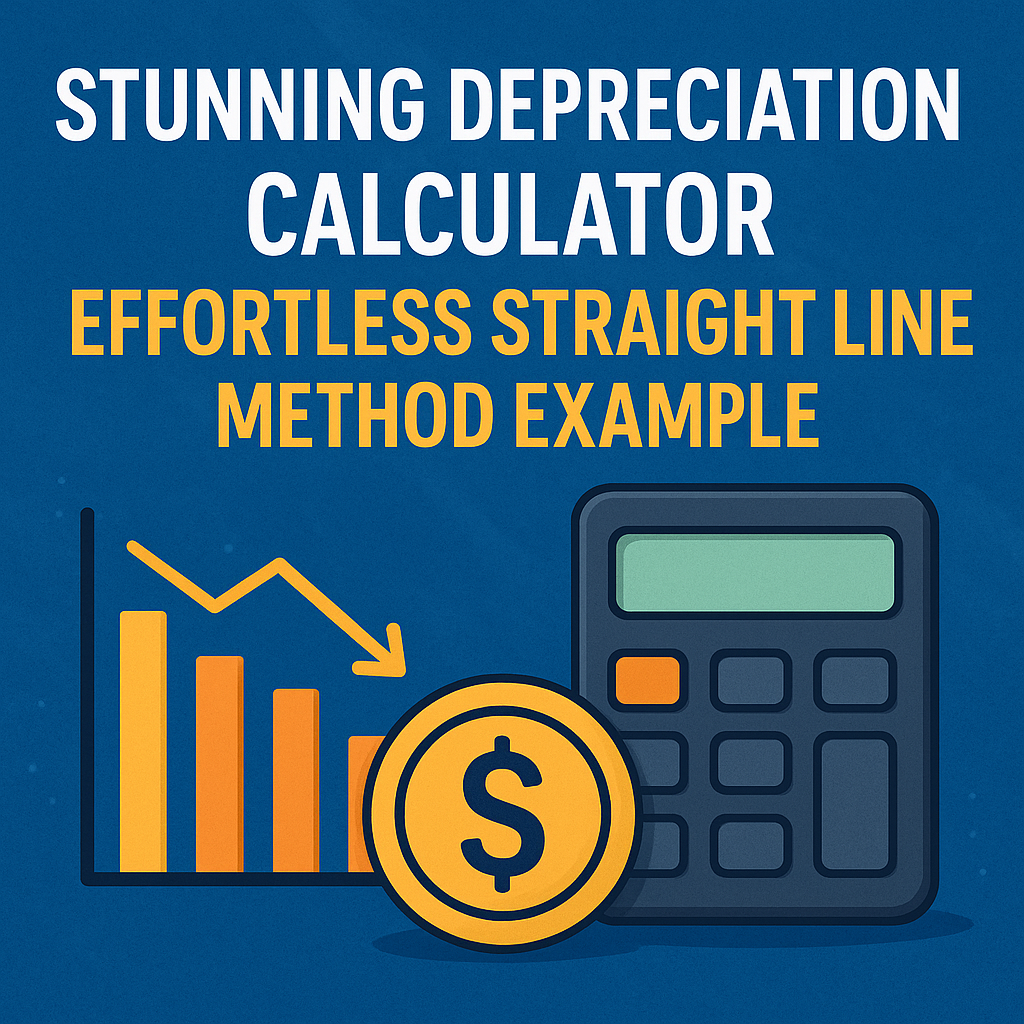
- Understanding the Depreciation Calculator: Straight Line Method Example
- What is Depreciation?
- What is the Straight Line Method?
- Steps to Use a Depreciation Calculator for the Straight Line Method
- Depreciation Calculator Straight Line Method Example
- Example Scenario
- Step-by-Step Calculation
- Benefits of Using a Depreciation Calculator
- Conclusion
Understanding the Depreciation Calculator: Straight Line Method Example
The depreciation calculator straight line method example is an essential tool for businesses and individuals who need to understand how to spread the cost of an asset over its useful life. Depreciation plays a crucial role in accounting, allowing organizations to allocate the wearing out of an asset systematically. This article will explore the straight line method of depreciation, provide a step-by-step guide on how to use a depreciation calculator, and illustrate the process with an example.
What is Depreciation?
Depreciation refers to the reduction in the value of an asset over time. Assets such as machinery, vehicles, and buildings lose value due to wear and tear, obsolescence, or other factors. For accounting purposes, it’s essential to report this decline in value accurately. By using depreciation, businesses can match revenue with expenses, giving a clearer picture of their financial health.
What is the Straight Line Method?
The straight line method is one of the simplest and most common methods for calculating depreciation. In this method, an equal amount of depreciation expense is recorded each year over the asset’s useful life. This simplicity makes it appealing for businesses, as it allows for straightforward financial planning and analysis.
Steps to Use a Depreciation Calculator for the Straight Line Method
Using a depreciation calculator with the straight line method involves several straightforward steps:
-
Determine the Cost of the Asset: This is the initial purchase price or acquisition cost of the asset.
-
Estimate the Salvage Value: The salvage value is the expected value of the asset at the end of its useful life. This is how much you expect to sell it for after depreciation.
-
Determine the Useful Life: The useful life is the period over which the asset is expected to be useful, expressed in years.
-
Calculate Annual Depreciation Expense: The formula to calculate annual depreciation using the straight line method is:
[
text{Annual Depreciation Expense} = frac{text{Cost of Asset} – text{Salvage Value}}{text{Useful Life}}
] -
Input Values in a Depreciation Calculator: Enter your asset’s cost, estimated salvage value, and useful life into a depreciation calculator to get your annual depreciation expense.
Depreciation Calculator Straight Line Method Example
Let’s illustrate the process with a clear example.
Example Scenario
Suppose a company purchases a delivery truck for $50,000. The estimated salvage value at the end of its useful life is projected to be $5,000, and the company anticipates the truck will be useful for 10 years.
Step-by-Step Calculation
- Cost of the Asset: $50,000
- Salvage Value: $5,000
- Useful Life: 10 years
Using the formula:
[
text{Annual Depreciation Expense} = frac{50,000 – 5,000}{10}
]
Calculating this gives:
[
text{Annual Depreciation Expense} = frac{45,000}{10} = 4,500
]
This means the company will record a depreciation expense of $4,500 annually for the truck over the 10-year useful life.
Benefits of Using a Depreciation Calculator
Employing a depreciation calculator offers numerous advantages:
- Accuracy: It reduces the chance of human error in calculations.
- Efficiency: Quickly calculates depreciation without extensive manual calculations.
- Financial Planning: Helps businesses budget for asset replacement and maintain a clearer financial outlook.
Conclusion
A depreciation calculator straight line method example simplifies asset management for businesses. By allowing straightforward calculations, it helps in recognizing expenses accurately and enables better financial planning. Understanding how to assess depreciation through this method empowers businesses to manage their financial statements more effectively, ensuring compliance with accounting standards and providing a clearer picture of their asset management strategies. Whether you’re a business owner, accountant, or student, mastering this method is a valuable skill that fosters good financial practices.
📱 Calculate Instantly with FinLaa
Access 116+ financial calculators — EMI, SIP, tax, mortgage & more — completely free. Works offline too.
iPhone · iPad · Mac · Apple Vision Pro
📚 Related Articles
🔗 Official Resources
Author

rahulbachioppo@gmail.com
Related Posts
how to calculate break even point with formula
Financial literacy is the skill of managing your money effectively. This tool helps you make data-backed decisions. In this guide, we explore...
Read out all
business valuation calculator for small business
Financial literacy is the skill of managing your money effectively. This tool helps you make data-backed decisions. In this guide, we explore...
Read out all
how to calculate depreciation of assets for tax
Every rupee saved in tax is a rupee earned. Efficient tax planning is 100% legal and necessary for financial health. In this...
Read out all
how to calculate net present value step by step
Financial literacy is the skill of managing your money effectively. This tool helps you make data-backed decisions. In this guide, we explore...
Read out all
break even analysis calculator for small business
Financial literacy is the skill of managing your money effectively. This tool helps you make data-backed decisions. In this guide, we explore...
Read out all
profit margin calculator for product pricing
Wealth creation is a marathon, not a sprint. Smart investing is about time in the market, not timing the market. In this...
Read out all